The Parts · The Trip · The Safety Checks
The Answer
Written by the Lift Shop team
How does a home lift work? A cabin travels up and down guide rails inside a shaft. A drive moves it, and a controller runs each trip: it checks that every door is closed and locked, starts the drive, then slows the cabin and stops it level with your floor before the door opens.
A home lift, also called a home elevator, is built for one household, so it is smaller and slower than an office lift. Below, we follow one trip step by step and explain the checks that run every time.
The Parts
A home lift has five main working parts: the shaft, the cabin, the guide rails, the drive and the controller, plus a door and a call button at every floor.
| Part | What it does | Where you find it |
|---|---|---|
| Shaft | Encloses the cabin and its rails, and carries the lift's structural loads | From the pit to the shaft roof; usually built by your builder to our drawings |
| Cabin | The enclosed box you ride in (lift professionals call it the car) | Inside the shaft |
| Guide rails | Guide the cabin so it travels straight and steady | Full height of the shaft |
| Drive | Raises and lowers the cabin | In the shaft, with some equipment in a small cabinet nearby |
| Controller | The lift's computer: answers the buttons, runs the safety checks, tells the drive when to start and stop | With the lift's equipment, in or near the shaft |
| Landing door | A door at each floor with an interlock, a call button plate and an emergency key access point | Every landing |
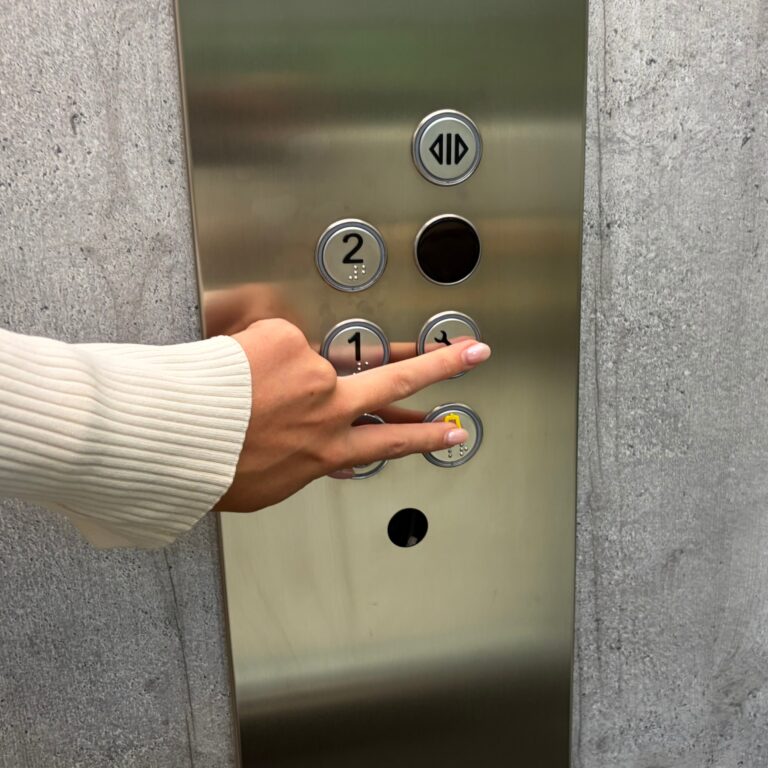
| Car operating panel | The cabin's buttons, with the two In Cabin Self Rescue buttons and the flush emergency phone | Inside the cabin |
Words such as pit, headroom and travel are defined in our glossary of home lift terms.
One Trip, Step by Step
When you press the button, the controller checks that the lift is safe to move, sends the cabin to your floor, stops it level with the landing and lets you out, in five steps.
You call the lift. Press the landing call button once. One-Touch operation is standard on our lifts, so the lift travels to the floor on its own; you don't hold the button down. With sliding doors, hands-free operation is available as an option, and a simple gesture calls the lift.
The controller checks the doors. Before the cabin moves, the controller confirms the landing doors are closed and locked. Our door interlocks stop the lift moving unless every door is closed, so a door left open on any floor keeps the lift where it is.
The cabin travels. The controller starts the drive, which moves the cabin along its guide rails, then slows it near your floor. Our A and C Series travel at 0.30 metres per second, about 10 seconds between two floors. The E Series with sliding doors is twice as fast, about 5 seconds.
It levels at the landing. The controller stops the cabin level with the landing floor, which is why your builder finishes each landing floor level with the lift's sill.
The door opens. Sliding doors open automatically. Swing doors are opened by hand and close on their own, and infrared detectors stop them closing on anyone in the doorway. Inside, press your floor once and the same checks run again.
The easiest way to understand a trip is to take one: our showrooms have working lifts, and you can press the buttons yourself.
The Drive
The drive is the machinery that raises and lowers the cabin. Home lifts use three main drives: electric, gearless electric and hydraulic. Each one moves the cabin in a different way, as the US Department of Defense design criteria for lifts describe.
An electric motor turns the drive through a gearbox. The gearbox lets a smaller motor lift the cabin at a steady, controlled speed.
The motor turns the drive directly, with no gearbox in between. With fewer moving parts, the ride is quieter and smoother and uses less energy.
An electric pump pushes oil into a cylinder, and the piston raises the cabin. To come down, a controlled valve lets the oil back out.
The three drives differ in noise, energy use and how well they suit an existing structure. Our guide to home lift drives compares them side by side. The drive is a choice inside a lift, not a type of lift in itself: see the kinds of home lift.
The Machine Space
Some lifts do, but no Lift Shop lift needs a dedicated machine room. Instead, each series has a small machine space for its equipment:
700 x 450 x 1800 mm
840 x 600 x 300 mm
400 x 300 x 2100 mm
These are common minimum dimensions, and lower and alternative dimensions are always possible. On the A Series, that cabinet can go in joinery, under the stairs or in a basement. To see every specification, compare the A, C and E Series side by side.
Every series runs on ordinary single-phase power, and most homes need no three-phase upgrade. We handle everything up to an isolator (a switch that cuts power to the lift), and supplying that isolator and wiring it to the mains is a job for your builder or electrician. Our guide to how a lift is installed, step by step covers the electrical work.
The Safety Checks
Every trip depends on a chain of checks: the lift will not move unless every door is closed, and sensors watch the doorway and the load.
The devices a lift must have are set by the standard it is built to. In Australia that is AS 1735, and its part for home lifts covers automatically controlled, small, low-speed passenger lifts in a private residence. We build and install our lifts to AS 1735, the Australian Standard for lifts.
Our technicians test every safety system, In Cabin Self Rescue and the door interlocks included, each time they service the lift. How a home lift keeps your family safe covers each feature in turn.
Power
In a blackout, a Lift Shop lift runs on its battery backup to the nearest floor and opens its doors.
If the cabin ever stops between floors, In Cabin Self Rescue, which every A, C and E Series lift has as standard, lowers it to floor level while the passenger holds down two buttons in the cabin. Our guide to what happens in a power cut or a breakdown sets out what to do, step by step.
Largely, yes. A home elevator uses the same basic parts: a cabin on guide rails, a drive, a controller and interlocked doors. It is built for one household, so it is smaller and slower, and Australia has a separate part of the lift standard for it. That part of AS 1735 covers automatically controlled, small, low-speed passenger lifts installed in a private residence.
The controller knows which floor you chose. As the cabin nears it, the controller tells the drive to slow down, then stops the cabin level with the landing. Modern lift control systems can also detect very small movements of the cabin and level it again if needed.
It depends on the drive. In a traction lift, a counterweight on the other side of the sheave balances much of the cabin's weight, so the motor only has to move the difference. In a piston-driven lift, fluid pushes the piston that raises the cabin instead. Our guide to home lift drives explains how each one works.
Most do, and ours are designed around a shallow pit below the lowest floor, formed by your builder. The pit starts from about 150 mm on the A Series; the C Series prefers 200 mm (150 mm is available) and the E Series needs 270 mm, all indicative. Lower and alternative dimensions are always possible, and our lift shaft guide explains what your builder needs to know.
Contact Us
Try before you buy. At our showrooms in Sydney, Melbourne, Brisbane and Perth (Canberra is opening soon), you can ride working lifts, press the buttons and have the safety features demonstrated. A Lift Consultant can look at your plans with you. To take the detail home, download our brochure.
Your quote is prepared the same day, and our guide to home lift costs explains what moves the price. Call us on 1800 440 714.
Prices move. Yours will not. Once you pay your first deposit, your price holds for 12 months.
Or talk it through with a Lift Shop consultant on 1800 440 714