


Lift Shop™ has sold and installed more than 10,000 home elevators over two decades.
Clients who have purchased the best lift for their situation are happy.
We like happy!
To learn the differences, visit our showrooms, and be happy.
Lift Shop™ is different, which is why we are often imitated and never duplicated.
Where we are not the best value proposition, we choose not to compete and will often recommend someone else.
Page Index
You must visit their showroom or work premise before paying anything to anyone.
Websites and the internet can fool many, and have.
Try the products before you buy them, and get to meet the team.
People are often more cautious with Tinder, than with their home lift supplier.
Tools and Strategies to Independently Check Suppliers:
| Purpose | Link to Look Up |
|---|---|
| Required by the QLD government | QBCC |
| Required to install lifts in NSW | NSW Contractors License |
| Required to install lifts in VIC | VIC Contractors License |
| Required to install lifts in QLD | QLD Contractors License |
| Required to install lifts in WA | WA Contractors License |
Required to sell lifts in Australia. Make sure the company you deal with is registered! | Work Cover Product Registration Look Up |
Lift Shop™ sells and installs a range of exclusive home elevators.
All the lifts are unique to Lift Shop™ and developed in collaboration with the manufacturers.
Lift Shop™ only sells proven lifts to ensure consistency and certainty for critical issues:
We are finding more clients are wanting to build an elevator shaft at the build stage and installing the lift later.
The benefits include:
Whether it is a stunning view or a busy living room many clients enjoy the luxury of being able to see what is going on around them while travelling in their private lift.
Although we have a full range of glass shafts (steel and aluminium) these pictures show some of the amazing glass shafts that builders have provided for a complete customised finish.
With our E series, we can supply the steel structural shaft components without any cladding. This assists in construction by removing the need to build a load-bearing shaft.
Once we have constructed our shaft structure, your builder will need to provide cladding on all four sides for safety purposes – this cladding will need to be both non-removable and non-penetrable.
Our self-supporting structure is available in a galvanised steel finish, not powder-coated, which allows for quick installation.
Many clients prefer a blend in look where they can tie their lift doors into the home’s decor.
This guide showcases various projects where clients have integrated/concealed their lift with a variety of custom finishes.
Discover key features, specifications, and benefits to find the perfect lift for your home and lifestyle.
| A Series - Italian | C Series - Italian | E Series - Italian | |
|---|---|---|---|
| Lead Time - Custom - 6 months *Stock and labour availability vary | ✓ | ✓ | ✓ |
| Speeds | 0.30 m/s 10 secs/floor | 0.30 m/s 10 secs/floor | up to 0.60 m/s 5 secs/floor |
| Capacity | 4 - 6 persons | 4 persons | up to 7 Persons |
Included: In Cabin Self Rescue | ✓ | ✓ | ✓ |
| Included: 1 month free storage | ✓ | ✓ | ✓ |
| Included: Scaffold for lift installation | ✓ | ✓ | ✓ |
| Included: GSM unit | ✓ | ✓ | ✓ |
Up to 6 floors | ✓ | ✓ | ✓ |
Cabin Sizes | ✓ | ✓ | ✓ |
Pit & Headroom Requirements | Pit Depth: 150mm Headroom: 2400mm-2600mm | Pit Depth: 190mm Headroom: 2550-2700mm | Pit Depth: 270mm Headroom: 2750mm |
Power Requirements: Single Phase | ✓ | ✓ | ✓ |
| Drive | Electric Hydraulic | Geared Electric | Gearless Electric |
Machinery Location | Small Cabinet Near lift | Small Cabinet 840 x 600 x 300mm | Machine Room Less |
The difference between drive types.
Which drive to use?
Is often confused.
This is caused by salespeople who want you to buy what they sell.
Rather than what is best for you.
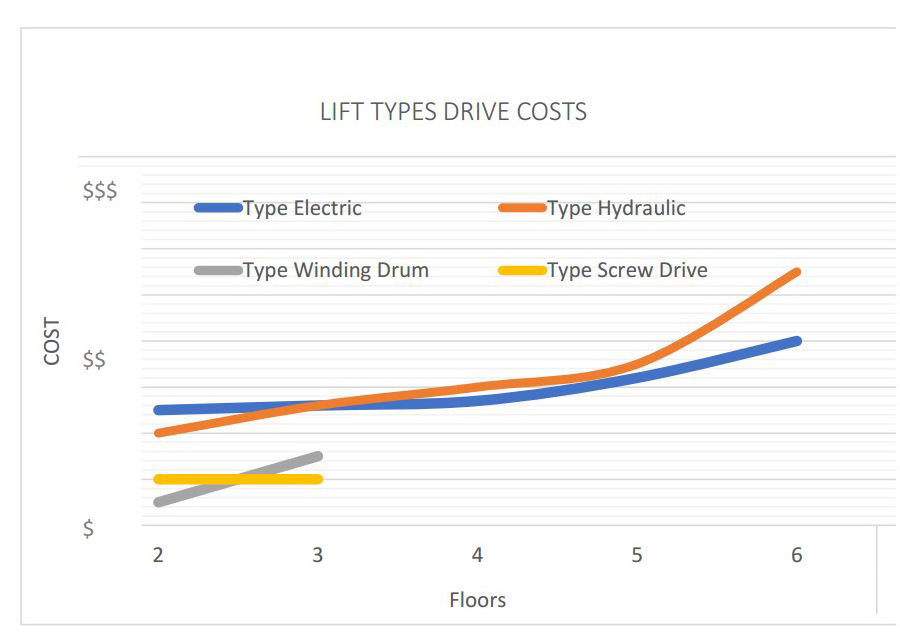
Our promise is your guarantee that oil smell is not an issue.

Explore residential lifts currently installed and maintained by Lift Shop™ in your local area, and don’t be surprised if your neighbour already has one and loves it.
Because safety is Paramount.
It is most important. It is not negotiable for clients or staff. Lift Shop™ has an enviable safety record for this reason.
The lifts have numerous safety features, so have them all demonstrated at your showroom visit.
A full list of the safety features can be found in the lift section.
In-Cabin Self Rescue, rescue from the machine space, emergency communication, power failure sensing lowering, and more. They are all different, but all critical to your safety.
Not all lifts are equal. Make sure you get the best.
Why it matters:
Home lifts are in homes, which are often locked to the outside world. An emergency technician may not be able to access your house!
Traditional elevators are in public locations, easily accessible by the general public.
How it works – In the event of a minor failure:
The battery-backed-up computer checks the landing doors for locked status. (it must be locked).
If the lift is not in its emergency brakes, the passenger presses and holds two buttons together and the lift slowly moves to floor level and unlocks the door for a safe exit.
The 2002 Australian standard for home lifts was written prior to Lift Shop™ including this invention of the in-cabin self-rescue device in 2007. It is allowed by the standard contrary to our competitors’ whimpering.
Unlike a public location where access to the property is simple, your home could be securely locked, meaning rescuers need to break in. You may be at home alone. A sensor for power failure (which we do have) alone is not enough in our honest opinion. You may agree with our competitors that it is enough.
Checked by WorkCover of NSW, the Lift Shop IN CABIN SELF RESCUE feature is entirely safe. Don’t wait for rescue, get yourself out!
Residential Lifts have become increasingly popular in Australia as homeowners seek to enhance accessibility and convenience within their private homes. These lifts are no longer exclusive to luxury homes; they can be tailored to various budgets.
The cost of a home lift in Australia can vary widely depending on several factors:
Lift Type: The type of lift you choose significantly affects the price.
Hydraulic Home Lifts: These are typically the most cost-effective, with starting prices at around $41,000 for a two-stop lift.
Traction Home Lifts: Premium traction lifts may start at $50,000 for a two-stop lift
Finishes and Customization: The level of customisation and finishes you select will also impact the price.
Additional Expenses: Remember that the lift’s cost is just one part of the overall expense. You should also allocate funds for finishing work around the lift and any necessary building works.
Recent changes to lift standards in Australia are quietly taking away the consumer benefits that once kept this industry fair.
Big global lift companies are tightening their control. They talk about safety and innovation, but behind the scenes, they push for rules that suit them. The result is less competition, higher prices, and fewer choices for homeowners and small businesses.
Follow the money.
It still flows to the same handful of multinationals who call the shots.
This isn’t new. In 2007, the European Commission fined the world’s biggest lift makers almost €1 billion for running a long-term price-fixing cartel. You can read the findings here:
European Commission 2007 Lift Cartel Report – Reuters.
The pattern is clear. When big corporations dominate the rules, consumers lose.
Standards are meant to keep people safe, not protect market share. Here’s what the key terms really mean:
A withdrawn or superseded standard isn’t illegal, it just means there’s an update. The problem is when big players twist that language to block others from competing.
At Lift Shop, we believe in transparency and real safety, not red tape or spin.
The Standards are being systematically replaced with EN (European Normative) and other overseas standards. The reason is allegedly on a justification that they are safer, without explaining why they are needed. The existing standards are already safe, and all they will achieve is to restrict competition. They dare not suggest the existing standards are unsafe in the first place for fear of being held to that or causing unnecessary product recalls for which there is no need.
The Australian Standards are flagrantly replaced by European ones only to assist International companies in making profits in Australia to the exclusion of the Australian market. If you feel strongly, report it to the ACCC.
Lift Shop™ is not protesting, merely reporting. Lift Shop™ is likely to benefit from this anti-competitive practice due to our already well-established size and scale and engineering strengths. The conduct will cause our smaller Australian competitors with limited resources to struggle and make it nearly impossible for them to innovate.
Lift Shop™ does not collude and refuses to take part in any anti-competitive or border line illegal conduct
Status of the standards below.
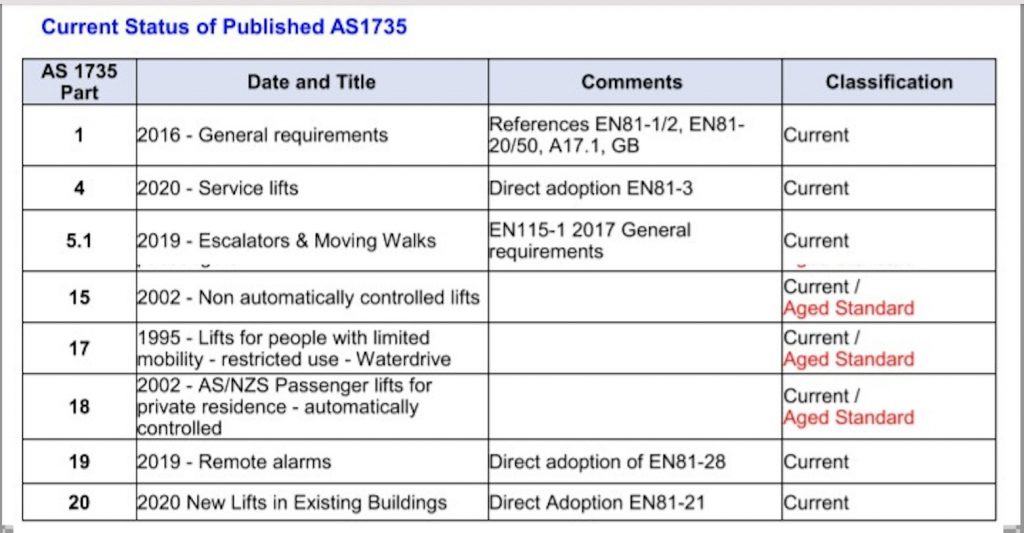
Residential Lift Solutions designed to suit your home, enhance your lifestyle, and support the way you live.
Step inside one of our showrooms to experience the quality, style, and performance of our residential lifts firsthand.
Thinking about installing a lift in your home? Get a personalised quote with no pressure or obligation. It’s quick, easy, and tailored to your space and needs.
Ask your supplier for their lift contractor licence number and verify it through your state or territory’s work health and safety regulator. In New South Wales, for example, licences can be checked through SafeWork NSW. A legitimate supplier will provide licence details upfront and welcome verification.
Lift Shop’s licences and independent certifications are published on our website with direct look-up links for authentication. We’ve held our licences continuously since 1996 and maintain full compliance with Australian Standards.
Hydraulic lifts use an electric pump to push fluid into a cylinder, raising the cabin. Electric traction lifts use a motor and counterweight system with steel ropes or belts. The key differences are noise, energy use, pit depth, and space requirements.
Our A-Series hydraulic lift operates at 0.30 m/s on single-phase 32A power and suits retrofits with its compact footprint. The C-Series and E-Series electric traction lifts are quieter (under 50 dB), require no machine room, and draw less energy per trip. Read our full comparison for detailed specifications.
No. Modern hydraulic home lifts use sealed systems with biodegradable oil that produce no noticeable odour during normal operation. The oil-smell association comes from older commercial lifts that used open hydraulic systems with industrial fluids.
Our A-Series hydraulic lifts have been installed in Australian homes since the early 2000s with no oil odour and minimal wear over time. The sealed pump unit sits in a separate cabinet, and the hydraulic fluid is contained within a closed circuit. Visit our A-Series page for full specifications.
Yes. Building the shaft during construction and installing the lift later is a smart approach that reduces future costs and structural disruption. We provide shaft drawings and specifications so your builder can construct a compliant, future-ready shaft now.
To future-proof properly, you need to confirm the internal shaft dimensions for your chosen series and door type, ensure adequate pit depth (from 150 mm depending on the model), provide correct headroom, and run power to the shaft location. See our shaft construction guide for full requirements.
In-Cabin Self-Rescue (ICSR) allows you to move the lift to the nearest floor and exit safely during a power failure — without waiting for outside help. We introduced ICSR in 2007, and it is fully compliant with Australian Standards and approved by WorkCover NSW.
Unlike public lifts where a technician is minutes away, home lifts are in private residences where help may take considerably longer. ICSR adds a third option beyond calling for help or automatic lowering: move yourself to safety and get out. It is a free inclusion on every Lift Shop lift.
A home lift provides a fully enclosed cabin with automatic doors, overload sensors, emergency communication, and In-Cabin Self-Rescue — features that a stairlift cannot match. Stairlifts travel on an open rail along the staircase with no enclosure or door interlocking.
For older adults or anyone with mobility concerns, a home lift eliminates the need to transfer on and off a seat at each level. We include ICSR, a GSM emergency phone, and power-failure descent as standard. Explore our full range to find the right model for your home.
A home lift price depends on the series you choose, number of stops, cabin size, door type, finishes, and site conditions. Every project receives a detailed, fixed-price quote.
We offer three series to suit different budgets and requirements. Each quote includes supply, standard installation, testing, and handover. We lock your price for 12 months. See our detailed cost breakdown for more information.
Residential home lifts in Australia must comply with AS1735, the Australian Standard for lifts, escalators, and moving walks. The key parts relevant to home lifts include AS1735.1, AS1735.12, and AS1735.18.
Our lifts are engineered to meet and exceed AS1735.18 requirements. We also comply with EN81-41 and relevant National Construction Code provisions. Learn more about our safety and compliance approach.
Installing a home lift typically takes 4–6 months from site measure to handover. This includes design finalisation, Italian manufacturing, shipping, and on-site installation. We handle everything from initial design through to testing and handover.
Timelines depend on project complexity and site readiness. Read our buyer’s guide for a full overview.
Before requesting a quote, gather your shaft dimensions, number of floors, power supply location, preferred door type, and any access constraints such as narrow hallways or heritage restrictions.
If you have plans, bring them along. Visit our buyer’s checklist for all considerations.
‘Italian manufactured’ means the lift is designed and built end-to-end in Italy with full quality control. ‘European designed’ may mean it was built elsewhere.
Our lifts are made in Italy and have been installed in Australia since 1996. Learn more about our heritage.
Our lifts travel between 0.30 m/s and up to 0.60 m/s. A typical single-floor trip takes only seconds.
Speed matters more in larger homes or high-use environments. Explore our full range to compare specifications.